

- DISCOVERY Vessel Bottom Line
Discovery Channel Shark Research
- April 26, 2026
- Riviera Beach, Florida
Project Overview
Shark attacks are often sensationalized, yet the drivers behind predatory behavior—particularly in coastal species like bull shark—remain poorly understood. Bull sharks are responsible for a disproportionate number of nearshore bite incidents due to their ability to tolerate low salinity, frequent turbid environments, and overlap with human activity. However, identifying the specific triggers that lead to investigatory versus predatory bites is still a major gap in shark behavior research.
Bite marks are one of the most critical pieces of forensic evidence used to identify the species responsible for an incident. Differences in jaw morphology, tooth shape, and bite force influence the size, curvature, and spacing of bite impressions. While white sharks are often associated with large, crescent-shaped bites, bull shark bites tend to present as broader, more forceful impressions with distinct serration patterns. Despite this, there is limited controlled data directly linking bite mark characteristics to specific behavioral triggers in real-world conditions.
To address this, experimental approaches using decoys have been increasingly applied to simulate prey and human analogs in the water. By presenting sharks with controlled stimuli, researchers can better isolate variables such as movement, silhouette, and splashing that may elicit a feeding response. These methods allow for safer, repeatable testing of shark interactions while generating measurable bite data that can be compared across species and contexts.
Application
The application of this research provides valuable insight into how bull sharks interact with potential prey, particularly in situations where human activity overlaps with their natural hunting behavior. By analyzing bite imprints collected from decoys and comparing them to documented shark attack patterns, researchers can better identify species responsible for incidents, refine our understanding of predation triggers, and improve risk assessment in coastal environments. These findings can directly inform public safety guidelines, enhance education for ocean users, and support the development of non-lethal mitigation strategies that reduce negative human-shark interactions while promoting shark conservation.
Expedition Summary
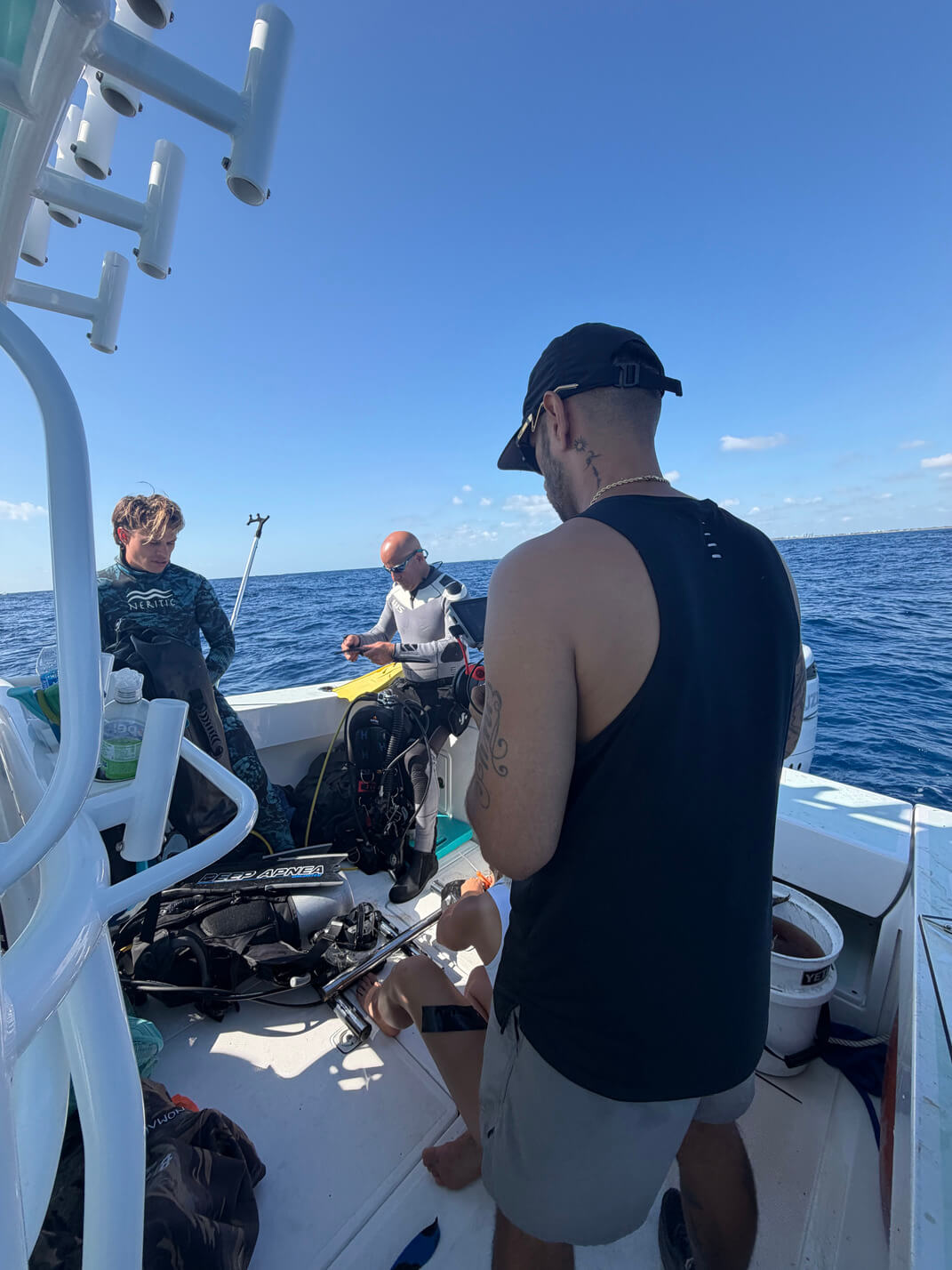
On April 26, 2026, The International SeaKeepers Society assisted a Discovery Channel film shoot for a natural history production focused on the predation strategies of bull sharks. The program was hosted by Rosie Moore and produced by Nicole Brait. During filming, a decoy was used to capture bite imprints from bull sharks, allowing for comparison with patterns observed in documented shark attack cases.
Location
Jupiter, Florida
Duration of Project
1 day
Leadership
- Nicole Brait, Producer
Research Team
- Rosie Moore, Host