
- DISCOVERY Vessels Bottom Line and Apex
Shark Tagging and BRUV Deployment Field Course with Shark Docs #2
- August 5, 2026
- West Palm Beach, FL
Project Overview
Shark Docs, led by Dr. Chris Malinowski and Dr. Brendan Talwar, leads field courses in marine conservation research and education. Field courses are the engine behind long-term research initiatives focused on shark abundance, reef fish abundance, and sea turtle biology. Through direct capture of study species using scientific longlines and drumlines, the deployment of baited remote underwater video units (BRUVs), and data collection via roving diver surveys coupled with laser-equipped cameras (SMILE cameras), field course participants become active researchers collecting data on the abundance, size structure, health, and movements of species of conservation importance. Shark Docs also introduce students to wild sharks offshore through a safety-oriented shark snorkel, which can involve interactions with numerous species, such as Bull, Sandbar, Lemon, and Caribbean Reef Sharks. Further, they introduce students to sea turtle biology and physiology through ongoing projects such as nesting surveys, hatchling releases, and a behind-the-scenes tour of an active rehab hospital in collaboration with scientists at the Loggerhead Marine Life Center.
Importantly, a core strength of the courses is to not only introduce students to research processes and study species, but also to deliver to students the scientific tools and experience to pursue a career in marine biology and/or actively contribute to marine conservation as citizen scientists. Each student becomes a certified Level 2 Reef Fish Surveyor through Shark Docs’ Conservation Partner – the Reef Environmental Education Foundation (REEF) – which allows students to submit reef fish survey data to a globally recognized citizen science dataset. Fundamentally, Shark Docs seeks to train and inspire future biologists using the living laboratories of South Florida’s marine ecosystems.
Application
Course participants range from middle school to early career and graduate school. Shark Docs also works with teacher groups to build curriculum around their research experience and scale impact through the classroom. Meanwhile, ongoing research initiatives can inform policy around ecosystem health and conservation.
Expedition Summary
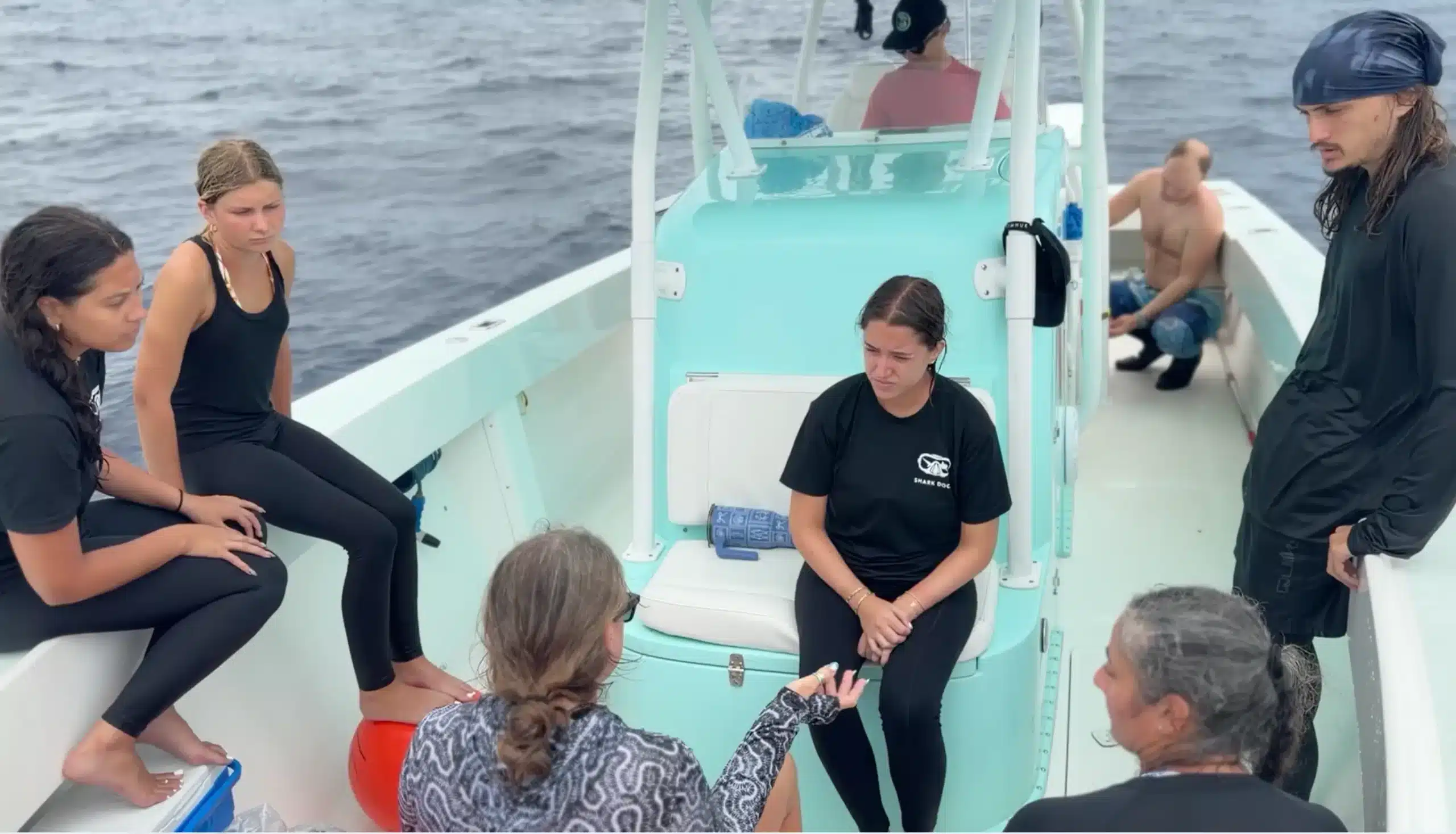
On August 5th, 2026, The International SeaKeepers Society assisted Shark Docs in conducting field research off the coast of West Palm Beach, FL. On this particular outing, the team was focused on measuring sharks to better understand demographics and size structure, sampling sharks for muscle and fin clips to support studies on animal health and population structure, and tagging animals to investigate movements. The research team also deployed baited remote underwater video systems (BRUVs) to investigate the relative abundance of shark species. With the help of SeaKeepers’ DISCOVERY Vessels Bottom Line and Apex, the team collected data from a Lemmon Shark, in addition to tagging the shark.
Additionally, participants snorkeled with sharks, giving them an up-close experience of just how magnificent these animals are. It was a very successful day full of data collection, tag deployment, and education for all involved.
Location
West Palm Beach, FL
Duration of Project
Field courses run annually between June, July, and August, with about six days of field work in total with support from the International Seakeeper’s Society.
Leadership
Research Team
Dr. Chris Malinowski
Ethan Dewald
Morgan Cleary
Ezra Malchek
Victoria Maroun
Ryan Hallberg
Naomi Grandville
Riley DeFilippis
Regan Olandese
Scarlet Chatham
Cristina Del Castro
Kali’a Victorino-Smith
Kayla Kennedy