

A lost shoe. A forgotten Barbie doll. Discarded beach toys. A pair of underwear. These are some of the odd items SeaKeepers volunteers collect during their efforts to remove trash from South Florida coastlines. Some of these items make sense – beach toys on a beach – but some always raise the question “how did that get here?” Amidst these weird finds are several repeat offenders, items and materials that we are guaranteed to collect at a cleanup, often in large quantities. Aside from visual surveys and conversations with volunteers when they return to empty their bucket into a trash bag, how can we accurately collect marine debris data and observe trends?
Marine Debris Tracker
Enter Marine Debris Tracker, a mobile app and data platform designed to allow citizen scientists to record and report data on litter found in the environment. The app was developed in 2010 through a partnership between the National Oceanic and Atmospheric Administration (NOAA) Marine Debris Program and the Southeast Atlantic Marine Debris Initiative at the University of Georgia College of Engineering. Since the shoreline cleanup program at SeaKeepers Headquarters kicked off in 2018, volunteers have removed over 36,000 pounds of trash at more than 285 cleanups, and have been logging marine debris data all over South Florida.
So what have we found?
Using Marine Debris Tracker, SeaKeepers volunteers have reported and categorized over 51,000 pieces of litter, which we are able to break down into material types and top items.
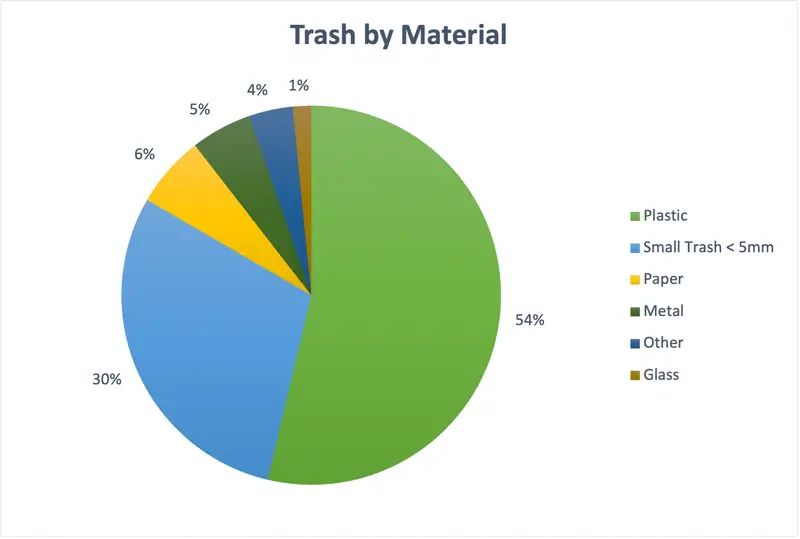
Over half of all the items logged were made of plastic, and nearly one third were trash smaller than 5 mm.
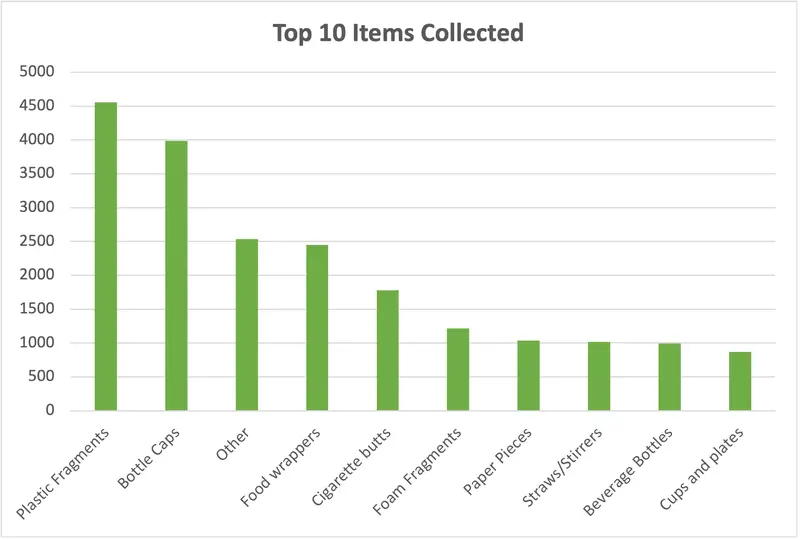
The top items we collected at cleanups were overwhelmingly plastic fragments and bottle caps, followed by food wrappers and cigarette butts.
Why does this data matter?
Not all marine debris is created equal! Marine debris size and material not only influence where it ends up in the environment and how long it will last there, but also what sort of harm it may pose to the local marine life. Over half of the trash logged at SeaKeepers cleanups was made of plastic, a material that has become infamous for its harmful impacts on the environment. Compared to materials like cardboard and paper, plastic takes much longer to degrade, persisting in the environment. The exact rate of this degradation varies by plastic polymer, surface area, and thickness, as well as the presence of additives and stabilizers meant to increase durability. Once in the environment, factors such as UV exposure, heat, sediment grain size, and bacteria presence cause the plastic to begin to break down into smaller pieces, called microplastics once they are less than 5 mm in length.
A 2020 study by The American Chemical Society found that the half-life of single-use plastics such as plastic grocery bags made of Low-Density Polyethylene and milk cartons or laundry detergent bottles made of High-Density Polyethylene ranged from 3.4 to 58 years in the ocean, and considerably longer on land (Chamas et al., 2020). As plastic breaks down, it leeches chemical additives – such as stabilizers and flame retardants – into the water, furthering the contamination.
Impact on Marine Life
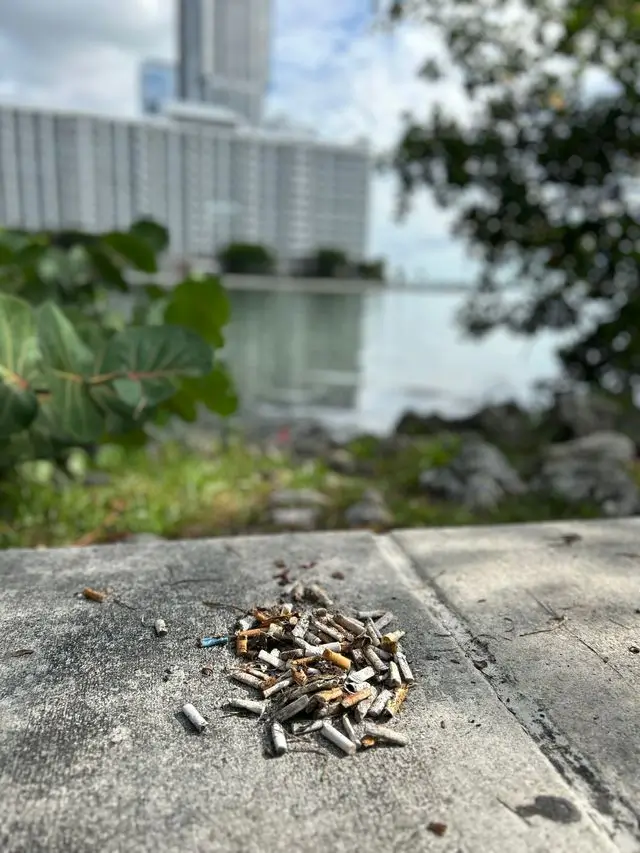
As plastics fragment and turn into microplastics, they pose a whole new threat to the ecosystem. Their small size makes them extremely pervasive and likely to be accidentally ingested by both passive feeders and active feeders. Many species of mussels, which feed by trapping algae and bacteria in their gills (filter feeding), accidentally ingest microplastics, which can accumulate in their tissue. Active feeders, such as pelicans or tuna, may accidentally eat microplastics while catching fish, and also ingest the microplastics in their prey. One 2020 study found that around 30% of seabirds, more than 4% of marine mammals, and 32% of sea turtles had plastic in their stomachs (Kühn and van Franeker, 2020). When inside marine life, this plastic can create a sensation of fullness, release harmful chemicals, and potentially rupture internal organs. The top items collected at SeaKeepers cleanups were small pieces of debris – with plastic fragments, bottle caps, and cigarette butts in the top five most common items – suggesting plastic ingestion is a big threat to local marine life.
How You Can Help
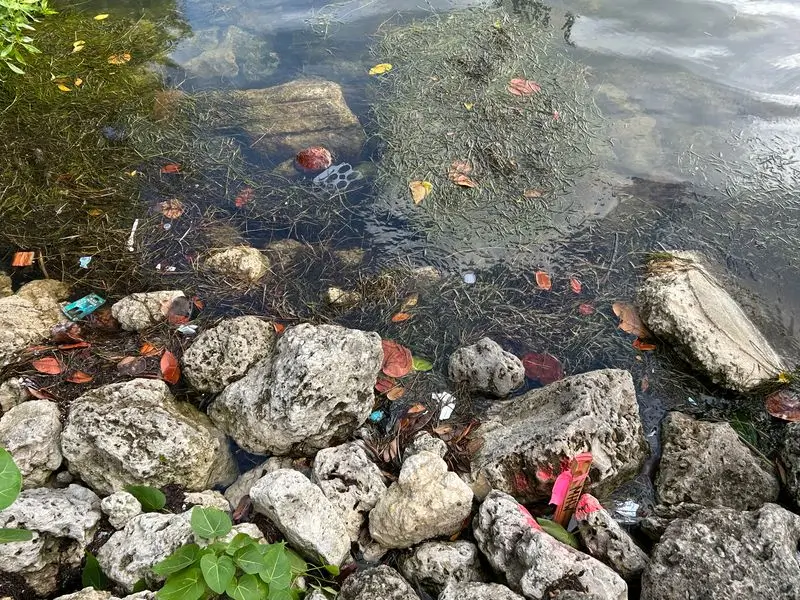
How can we reduce the number of organisms dying from causes related to plastic ingestion? It starts with bringing awareness to the issue and inspiring real change. Attending beach cleanups is a great way to reduce marine debris on coastlines, with one case study in Norway finding that repetitive coastal cleanups reduced microplastics on land and in the sea by 99% after one year (Take 3 for the Sea, 2023). To maximize the impact of coastal cleanups and create long-term impact, data collection is essential to understanding the crisis we face and finding solutions that will last. Marine Debris Tracker Data can be used to inform policy and justify legislation such as plastic bag or styrofoam bans, which reduce pollution at the source. Recent legislation proves this! After a social media campaign led by Surfrider Miami in 2022, cigarette smoking was successfully banned in city-owned parks and beaches, as a pathway to reduce cigarette butt pollution. In 2024, a bill was passed that banned intentional balloon releases in the state of Florida after Clean Miami Beach endorsed the bill and urged representatives to sponsor it. Now, all eyes are on the Farewell to Foam Act that was introduced to Congress in 2025, which would ban the sale and distribution of styrofoam products by 2028. Data on the prevalence of these types of debris is crucial to the efforts to ban them, making the job of citizen scientists more important than ever.
To start contributing data, download Marine Debris Tracker here. To join the effort to protect our oceans, learn about SeaKeepers cleanups here.
References:
- Chamas, A., Moon, H., Zheng, J., Qiu, Y., Tabassum, T., Jang, J. H., Abu-Omar, M., Scott, S. L., & Suh, S. (2020). Degradation rates of plastics in the environment. ACS Sustainable Chemistry & Engineering, 8(9), 3494–3511. https://doi.org/10.1021/acssuschemeng.9b06635
- Eich A, Weber M, Lott C. Disintegration half-life of biodegradable plastic films on different marine beach sediments. PeerJ. 2021 Aug 10;9:e11981. doi: 10.7717/peerj.11981. PMID: 34434671; PMCID: PMC8362673.
- It’s a fact – beach clean-ups matter! Take 3 for the Sea. (2023, October 31). https://www.take3.org/its-a-fact-beach-clean-ups-matter/
- New Florida law comes into effect with hefty fine for intentional balloon releases. Local 10 News. (2024, July 2). https://www.local10.com/news/local/2024/07/01/new-florida-law-comes-into-effect-with-hefty-fine-for-intentional-balloon-releases/
- NOAA Marine Debris Program. (2023, February 7). Ingestion. Marine Debris Program | NOAA. https://marinedebris.noaa.gov/why-marine-debris-problem/ingestion
- Surfrider Foundation. (2022, September 14). Ban Butts from Our Beaches, Miami Beach. Surfrider Foundation Miami . https://miami.surfrider.org/campaigns/Ban+Butts+from+Our+Beaches%2C+Miami+Beach
- Susanne Kühn, Jan Andries van Franeker, Quantitative overview of marine debris ingested by marine megafauna, Marine Pollution Bulletin, Volume 151, 2020, 110858,ISSN 0025-326X, https://doi.org/10.1016/j.marpolbul.2019.110858.

Written by: Lillian Engelhard