

Regardless of its origin, waste from our communities inevitably makes its way to the ocean, accelerated by wind and rain that transport debris through rivers, canals, and storm drains. Once this trash becomes marine debris, where does it go?
How Trash Moves Through the Ocean
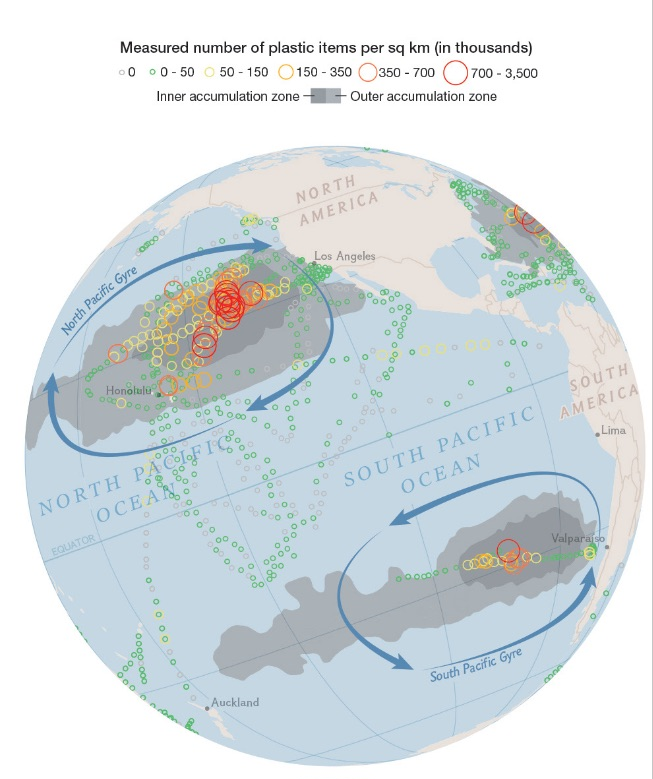
When trash enters the ocean, it can be transported great distances by ocean currents. Surface winds and density differences in water masses generate large-scale currents in our ocean, which move vast amounts of water across the globe. Global wind patterns, the Earth’s rotation, and the shape of coastlines contribute to the formation of gyres- large, rotating systems of interconnected currents. These gyres act like a vortex, their circular nature drawing water from coastal regions toward their calm center.
There are five major gyres in the ocean: the North Atlantic, South Atlantic, North Pacific, South Pacific, and Indian Ocean Gyres, and within each lies a garbage patch. Twice the size of Texas, the Great Pacific Garbage Patch is a vast accumulation of marine debris located in the North Pacific Gyre. On the surface, the garbage patch doesn’t look like the sea of plastic bottles that may come to mind. The patch consists primarily of microplastics, giving the water a cloudy soup-like appearance.
A New Ecosystem on Marine Debris
The outcome of these large aggregations of debris has been something unexpected- the surface area of this floating trash has created a new marine habitat, with recent studies finding that coastal organisms are rafting on marine debris and establishing colonies in the open ocean. Many species of crustaceans and other coastal creatures that previously could not survive in the open ocean are now finding themselves far from home, and not only are they surviving, but they are also reproducing.
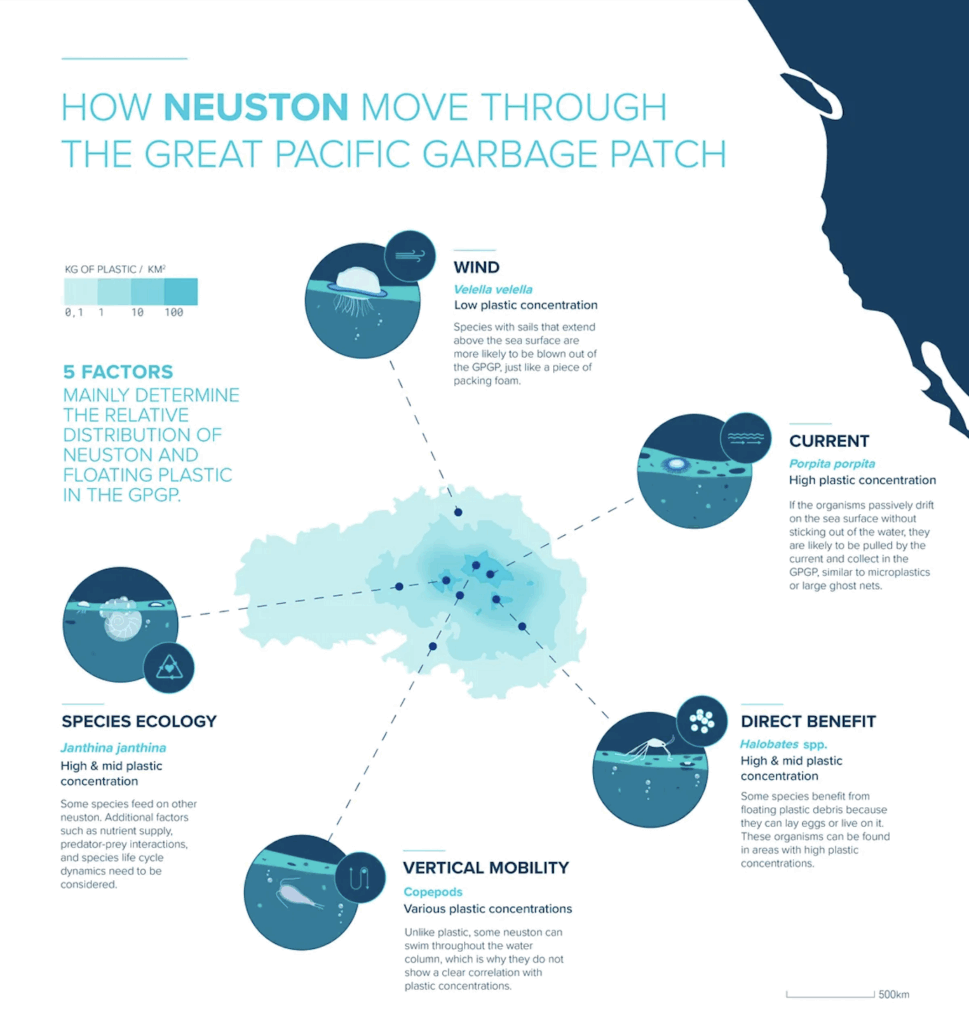
The organisms existing just below or above the sea surface, known as the neuston, are particularly susceptible to interaction with floating marine debris, as their passive mode of transportation makes them likely to accumulate in gyres and garbage patches. A study published by The Ocean Cleanup found that the distribution of neustonic organisms relative to plastic debris varies by species and is influenced by wind, currents, encounters with floating plastic objects, the organism’s ability to swim, and species-specific ecology. The study provides a foundation for further research into the impact of marine debris on neustonic distribution and its impacts on the ocean as a whole.
Cleanup Complications
Thus, the presence of neustonic and coastal organisms in garbage patches must be taken into account when discussing ocean cleanups as a solution. Removing debris will inevitably result in the loss of many neustonic organisms as bycatch, and further studies are needed to evaluate this risk and determine the environmental consequences. As humans navigate solutions to ecological issues, we must understand our power to completely change ecosystems and recognize that we cannot undo what has already occurred.

Interested in learning more about the neuston and its relationship with marine debris? One of SeaKeepers’ many citizen science projects, the Neuston Net Research Collective, equips boaters with a specialized net to perform plankton tows. Data collected by boaters interested in conservation helps support research on topics such as the geographic distribution of neustonic species, as well as the distribution of microplastics and their role in marine ecosystems. To learn more about the Neuston Net Research Collective, visit
https://www.seakeepers.org/program-opportunities/neuston-net-research-collective-conduct-plankton-survey-style-transects/.
References:
- Bartels, M. (2024, February 20). Surprising creatures lurk in the Great Pacific Garbage Patch. Scientific American. https://www.scientificamerican.com/article/surprising-creatures-lurk-in-the-great-pacific-garbage-patch/
- Egger M, Quiros L, Leone G, Ferrari F, Boerger CM, and Tishler M (2021). Relative Abundance of Floating Plastic Debris and Neuston in the Eastern North Pacific Ocean. Front. Mar. Sci. 8:626026. doi: 10.3389/fmars.2021.626026
- Garbage patches. Marine Debris Program, Office of Response and Restoration, National Oceanic and Atmospheric Administration. (n.d.). https://marinedebris.noaa.gov/discover-marine-debris/garbage-patches
- Great Pacific Garbage Patch. National Geographic. (n.d.). https://education.nationalgeographic.org/resource/great-pacific-garbage-patch/
- Ocean Gyre. National Geographic. (n.d.-b). https://education.nationalgeographic.org/resource/ocean-gyre/#