

Mitigation of Ship Strikes on Large Whales
Project Overview:
Program Partners
- Great Whale Conservancy
- Whale Guardians Program
Location
-
The west coast of Baja California, Mexico, between Southern California or northern Baja California and Cabo San Lucas.
Depending on vessel availability and logistics, the expedition may begin in Los Angeles, San Diego, Tijuana, Ensenada, or Cabo San Lucas. The preferred itinerary would complete one survey leg along the coastline in either direction, followed by a return survey in the opposite direction after one rest and logistical day.
Expected Time Frame
- November through December 10, 2026
Duration of Expedition
- The preferred expedition would consist of two approximately seven-day liveaboard survey legs, separated by one rest and logistical day. Vessels able to support only one of the two survey legs may also be considered.
Accommodation Needed
- 3 - 4 Researchers + 1 SeaKeeper Representative
Special Equipment Needed
- A licensed captain, vessel capable of safely completing an extended coastal and offshore passage between San Diego and Cabo San Lucas, access to a tender or smaller vessel for field operations, appropriate operational capabilities and clearances for an international itinerary between the United States and Mexico
Expedition parameters listed above are flexible and negotiable.
Background:
The west coast of Baja California is a globally significant habitat for large whales, supporting breeding, feeding, calving, and migratory activity for species including blue, fin, humpback, gray, Brydeโs, minke, orcas, and sperm whales.
The proposed expedition will take place during the blue whale calving season, providing an important opportunity to document the distribution and habitat use of mothers, calves, and other large whales along the Baja California Peninsula. These waters also experience substantial commercial vessel traffic, creating a risk of ship strikes, particularly for slow-moving whales and endangered species.
The project is led by Michael Fishbach, founding director of the Great Whale Conservancy, who has conducted permitted whale research throughout the Americas for more than 33 years. His blue whale research program off Baja California is entering its 32nd consecutive year, making it one of the longest-running datasets of its kind.
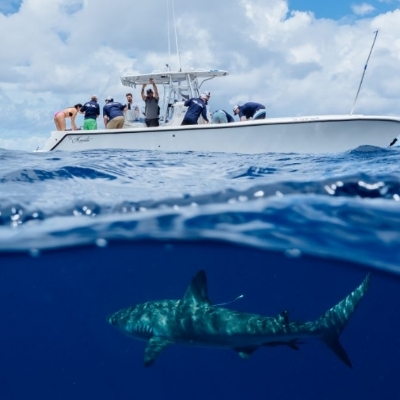
The shark research component will be conducted in collaboration with Dr. James Ketchum, co-founder and Director of Marine Conservation at Pelagios Kakunjรก. His expertise will allow the expedition to gather complementary information about sharks and other marine megafauna throughout the survey region.
Mission:
The mission of this project is to reduce the risk of ship strikes on large whales by identifying important habitats and seasonal patterns along the west coast of Baja California.
The primary objectives include:
- Conducting vessel-based surveys to document blue whales, other large whale species, and orcas along the Baja California Peninsula
- Documenting whale distribution and habitat use during the blue whale calving season
- Collecting spatial and temporal data that can be integrated into navigational mapping systems used by the commercial shipping industry
- Supporting the development of seasonal routing recommendations that reduce vessel traffic through whale-dense areas
- Contributing to the long-term recovery of endangered species, including blue whales, by reducing preventable ship-strike mortality
- Conducting complementary shark surveys in collaboration with Dr. James Ketchum and Pelagios Kakunjรก
- Improving the broader understanding of marine megafauna distribution along the west coast of Baja California
Applications:
Data collected during this Scientist-Led Expedition will be incorporated into specialized software capable of mapping whale sightings directly onto navigational charts used by commercial vessels. These maps allow researchers, Master Mariners, and shipping stakeholders to collaboratively identify areas of elevated collision risk and design voluntary or permanent routing measures that minimize overlap between vessels and whales.
Surveying the coastline in both directions will provide broader spatial coverage and allow researchers to document changes in whale distribution over the course of the expedition. Conducting the work during blue whale calving season may also provide valuable information about habitat used by mothers and calves, which could be especially vulnerable to vessel traffic.
Findings may support voluntary route adjustments and future legislative action aimed at establishing permanent shipping lanes that avoid important whale habitats. Data from the complementary shark surveys will also contribute to the understanding and conservation of marine megafauna along the Baja California Peninsula.
Beyond its conservation benefits, reducing ship strikes supports healthier whale populations that contribute to ocean productivity and sustain the regionโs growing whale-watching economy.
Get Involved
If youโre interested in learning more about this specific program opportunity, please reach out to our team below to find out more about this program or get involved in other opportunities with SeaKeepers.
Explore More Opportunities
At-Sea Opportunities
Citizen Science Opportunities
Education Opportunities